
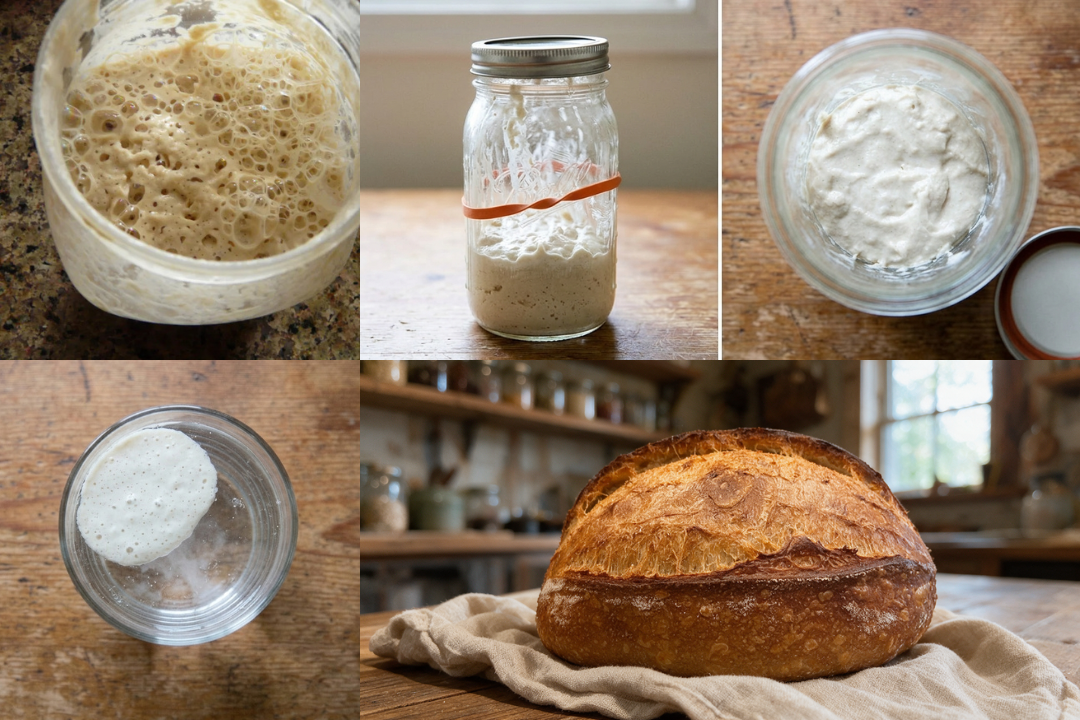
Sourdough: The Living Bread That Kept Pioneers Alive Without a Grocery Store
The prospectors who poured into the Klondike in 1898 carried something more valuable than their pickaxes and pans. Tucked inside a shirt, kept warm against bare skin through subzero Yukon nights, was a jar of gray, bubbling paste. Miners slept with it. They cradled it like a newborn, because if the yeast and bacteria inside froze and died, there would be no bread until spring. These men earned a nickname that stuck to an entire generation of frontier survivors. People called them “sourdoughs,” and the living culture they protected was often the only thing standing between them and a diet of hardtack and beans.
That same culture, a simple mix of flour and water teeming with wild microorganisms, is one you can build on your own kitchen counter this week. No packet of commercial yeast. No specialty equipment. Just flour, water, time, and an understanding of what your great-grandparents knew instinctively: that bread does not require a factory. It requires patience and the invisible life already floating in the air around you.
A Bread Older Than Written History
Long before anyone understood microbes, people were harnessing them. By 6,000 BC, Egyptian bakers were producing bread in large quantities, and the leading theory is that leavening was discovered there by accident: a bowl of flour and water porridge, left out too long, caught wild yeast from the air and began to bubble. Physical evidence of leavened sourdough bread survives from a lakeside site in Twann, Switzerland, dated to roughly 3,700 BC, showing the technique had already spread far beyond the Nile. By 77 AD, Pliny the Elder was describing how Roman bakers held back a portion of fermented dough from one batch to start the next, exactly how a starter works today. For thousands of years, this was not “artisan” bread. It was simply how bread was made.
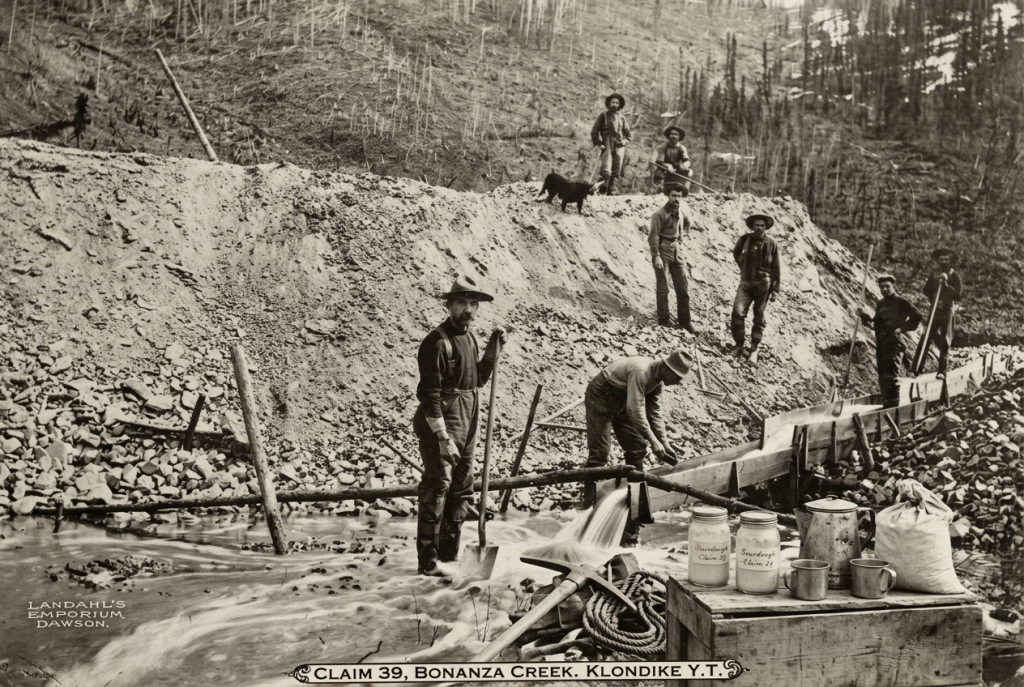
Then came San Francisco. When the Gold Rush erupted in 1849, a young baker named Isidore Boudin, from a family of master bakers in Burgundy, France, blended the wild sourdough already circulating among local miners with French technique, and “San Francisco sourdough” became a style all its own. Miners carried starters north into Alaska and the Yukon too, part of the same forgotten pioneer survival skills that kept people fed with nothing but knowledge and a jar of fermenting flour. The bread mattered enough to frontier life that in 1971, USDA researchers Leo Kline and T. F. Sugihara isolated the bacterium responsible and named it Lactobacillus sanfranciscensis, reclassified in 2020 as Fructilactobacillus sanfranciscensis. A microbe named after a Gold Rush town is doing the same work in kitchens worldwide right now.
What Is Actually Happening Inside That Jar
A sourdough starter is not a single ingredient. It is a living ecosystem, two different kinds of organisms working in partnership, and understanding that partnership is what separates people who bake great sourdough from people who throw out a “dead” starter every few weeks in frustration.
Wild yeasts, mostly species of Saccharomyces and a cooler-loving strain called Kazachstania humilis, drift in from the air and the flour itself, eating sugars and exhaling the carbon dioxide that makes your dough rise. A global research effort called the Sourdough Project catalogued more than 70 different types of yeast living in home starters, compared to the three strains commercial bakeries typically rely on. Alongside them live lactic acid bacteria, more than 50 species in the Lactobacillus family, producing lactic acid (that clean, yogurt-like tang) and acetic acid (the same acid found in vinegar). Together they drive the dough’s pH down to about 3.5 to 4.5, building flavor and acting as a natural preservative against mold and spoilage.
The two groups do not compete, they cooperate. Fructilactobacillus sanfranciscensis thrives on maltose, a sugar its yeast partner Kazachstania humilis cannot digest at all. The bacterium breaks it down and releases glucose, which the yeast happily consumes. By raw cell count, bacteria actually dominate this partnership, typically outnumbering yeast 100 to 1, though it is the yeast’s gas production that does the heavy lifting of raising the dough. And despite the name, this bacterium is not a San Francisco exclusive. It is the dominant organism in what scientists call Type I sourdoughs worldwide, so the same partnership that built San Francisco’s reputation is very likely already at work in the jar on your own counter. What actually shapes a starter’s local character is your kitchen’s wild yeast, your flour, your water, and your temperature, not some rare regional microbe.
Why Sourdough Was, and Still Is, the Ultimate Survival Bread
There is a reason this bread traveled with gold miners, sailors, and homesteaders instead of any other kind. Several reasons, actually, and every one of them matters more the further you get from a functioning grocery store.
It needs no purchased leavening. A packet of commercial yeast has a shelf life and depends on a supply chain. A sourdough starter renews itself forever from nothing but more flour and water. Feed it and it lives. In a genuine grid-down or supply-disrupted situation, the ability to make risen bread without buying anything is not a novelty. It is food security. This is the same principle behind stockpiling the right staples, and if you want to go deeper on that, our guide to long-lasting foods for any emergency covers what belongs in a serious pantry.
It keeps longer. That low pH from the lactic and acetic acids means a true sourdough loaf resists staling and molding far better than a soft supermarket loaf. Before refrigeration, this was everything. A bread that stayed edible for a week or more without spoiling was a bread that kept you alive between bakes.
The starter itself is nearly immortal. Neglect it in the fridge for weeks and it will develop a layer of gray liquid on top and go dormant, but it is usually not dead. It is waiting. A few feedings and it roars back to life. Bakeries have kept the same starter culture going for over a century. Families have passed starters down through generations. When you build one, you are not making a disposable ingredient. You are starting something that can outlive you.
If the idea of foods that store for the long haul and carry real nutrition appeals to you, sourdough sits alongside a whole category of nearly forgotten provisions our ancestors depended on. The Lost SuperFoods documents dozens of these, from the shelf-stable survival staples that fed armies to pioneer recipes most people have never heard of, the kind of food knowledge that used to be common and has quietly slipped away.
Building Your Starter From Scratch: The Seven-Day Process
You do not need to buy a starter or beg one from a friend, though both work. You can capture wild yeast from the air and your own flour in about a week. Here is the method that reliably works.
What you need: A clean glass jar (a quart mason jar is perfect), a kitchen scale if you have one, whole grain flour such as whole wheat or rye to start, all-purpose or bread flour for later feedings, and non-chlorinated water. Chlorinated tap water can slow down or harm the microbes, so if your tap is heavily treated, let the water sit out overnight or use filtered water.
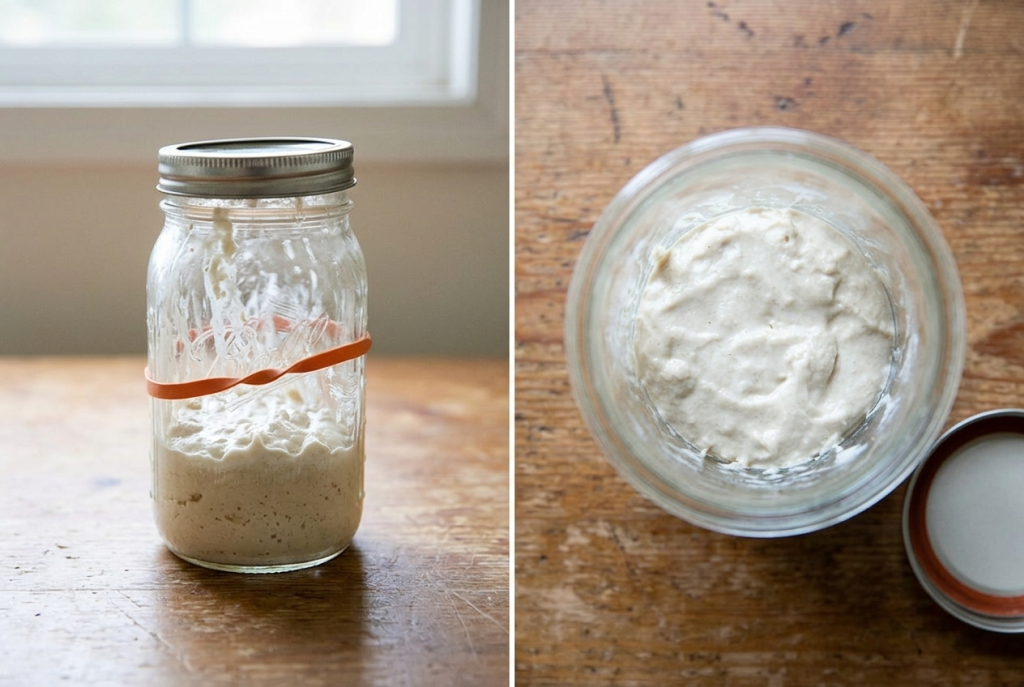
Day 1: In your jar, mix 60 grams of whole wheat or rye flour with 60 grams of lukewarm water. Whole grain flour is loaded with wild yeast and bacteria on the bran, so it kickstarts fermentation faster than white flour. Stir until no dry flour remains, scrape down the sides, and cover loosely. You want air exchange, not an airtight seal, so a lid resting on top or a cloth with a rubber band is ideal. Leave it somewhere warm, ideally around 70 to 78 degrees Fahrenheit.
Days 2 and 3: You may start to see a few bubbles and catch a slightly sour or even a funky, unpleasant smell. This is normal and temporary. Begin daily feedings. Discard about half of the mixture (this “discard” is not garbage, more on that below), then feed what remains with 60 grams of flour and 60 grams of water. Stir, cover, and wait.
Days 4 through 6: The character changes. The unpleasant early smell gives way to something pleasantly tangy and yeasty, almost like sour beer or yogurt. You should see the mixture rising and falling between feedings and developing a bubbly, foamy texture. Around now, switch to feeding with all-purpose or bread flour, or a blend, since the whole grain has done its job of establishing the culture. Consider feeding twice a day if your kitchen is warm and the starter is active.
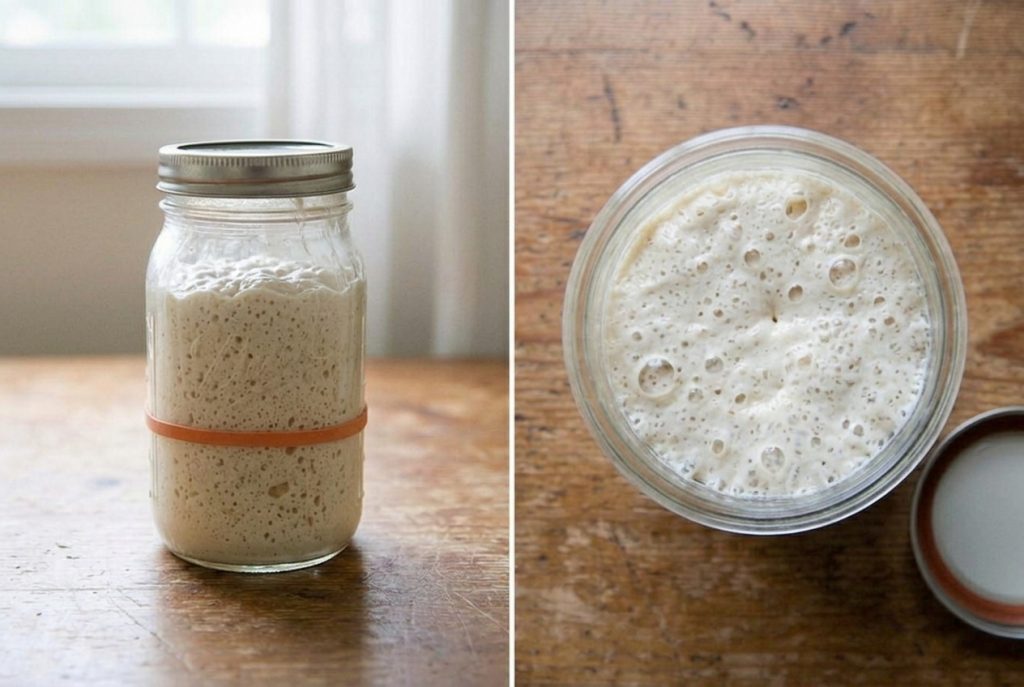
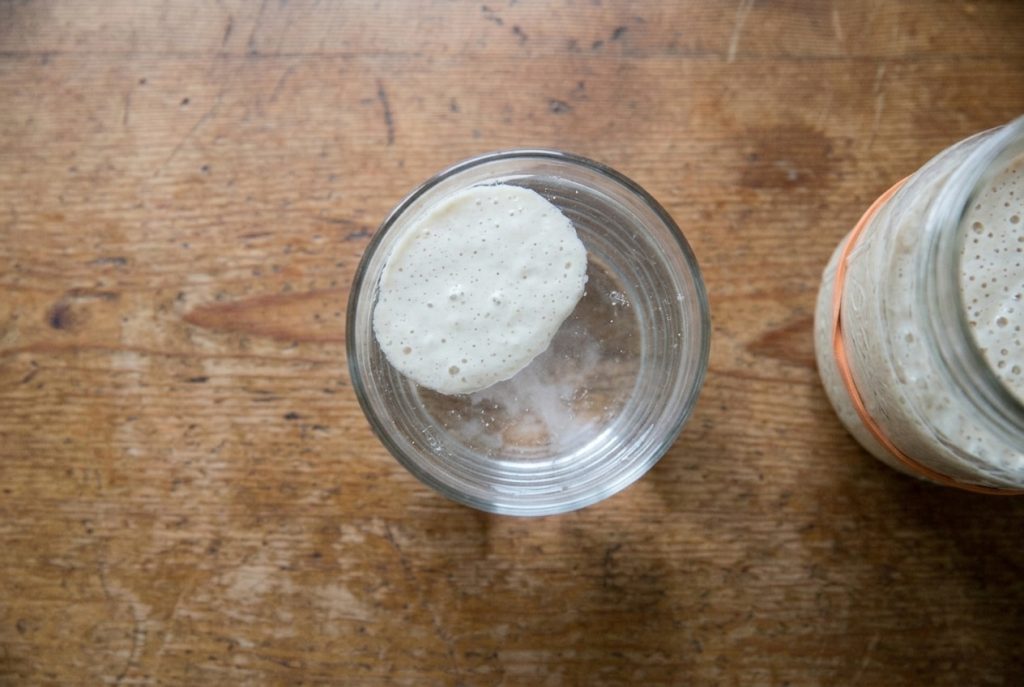
Day 7 and beyond: Your starter is likely ready when it reliably doubles in size within 4 to 8 hours of feeding, is covered in bubbles, and smells clean and tangy. The classic test: drop a spoonful into a glass of water. If it floats, it is full of gas and ready to leaven bread. This is called the float test. Some starters take 10 to 14 days to reach full strength, especially in a cold kitchen, so do not panic if yours is slow. Keep feeding.
Feeding and Keeping Your Starter Alive
Once established, a starter needs a rhythm. The concept is simple: you are farming microbes, and they need regular food.
A standard feeding uses a 1:1:1 ratio by weight. That means one part existing starter, one part flour, one part water. For example, keep 50 grams of starter, add 50 grams of flour and 50 grams of water. If you bake daily and keep your starter on the counter, feed it once or twice every day. The discard step matters here. Without removing some starter each time, the volume explodes and the acidity builds up faster than the yeast can stay strong.
If you are not baking every day, and most people are not, move the jar to the refrigerator. The cold slows the microbes to a crawl, and you only need to feed a refrigerated starter about once a week. When you want to bake, pull it out, give it a feeding or two at room temperature over a day to wake it up and get it active, then use it. Miners in the Yukon kept theirs warm against their bodies precisely because cold puts the culture to sleep. You are using that same principle in reverse, deliberately chilling it to press pause.
Do not throw your discard away without thinking. That removed portion is perfectly good food, just not yet risen dough. Sourdough discard makes excellent pancakes, waffles, crackers, biscuits, and flatbreads. In a household that wastes nothing, this is the kind of resourcefulness that connects directly to older food preservation and no-waste kitchen traditions our grandparents lived by out of necessity.
The Health Case: Why Fermented Bread Behaves Differently
Modern research has caught up to what traditional bakers sensed for centuries. The long, slow fermentation of sourdough does real chemical work on the grain, and it changes the bread in ways that matter for how your body handles it. This is not wishful thinking. It is measurable.
Grains naturally contain phytic acid, a compound making up roughly 1 to 5 percent of the dry mass of cereals. Phytic acid is often called an “antinutrient” because it binds to minerals like iron, zinc, magnesium, and calcium, preventing your body from absorbing them. Sourdough fermentation activates an enzyme called phytase, which breaks phytic acid down. The acidic environment of the starter, in the pH range of about 3.5 to 5.0, is exactly where phytase works best. Studies show that combining the bacteria and yeast in sourdough can reduce phytic acid by more than 40 percent, and under optimal conditions around pH 4.3 to 4.6, degradation can exceed 70 percent. The result is bread from which you actually absorb more of the minerals it contains.
Blood sugar response improves too. Ordinary white bread is a high-glycemic food that spikes blood sugar quickly. The organic acids produced during sourdough fermentation slow down how fast your body breaks the bread’s starch into sugar. Research indicates sourdough fermentation can move bread’s glycemic index from the high range down to medium, and when combined with added dietary fiber, the glycemic index can drop below 55, which is considered a low-GI food. For anyone watching their blood sugar, that is a meaningful difference from the same weight of standard bread.
There is also the matter of digestibility, and this is where sourdough helps many people who think they cannot tolerate wheat. Fermentation partially breaks down both proteins and certain hard-to-digest carbohydrates called FODMAPs before you ever eat the bread. One study measured a 16 percent increase in protein digestibility and an 18.7 percent improvement in the biological availability of the bread’s proteins. On the FODMAP side, one study found that just 12 hours of fermentation reduced fructans and raffinose, two common triggers of bloating and gut discomfort, by 69 percent, and some trials have achieved over 90 percent FODMAP reduction in whole wheat sourdough. This does not make sourdough safe for people with celiac disease, since it still contains gluten. But it explains why so many people with mild wheat sensitivity find that traditional long-fermented sourdough sits far easier in the gut than industrial bread. If gut health is your focus, sourdough pairs naturally with other traditional gut-supporting remedies like slippery elm, the pioneer bark that soothes the digestive tract.
Troubleshooting: Reading the Signs Your Starter Sends
A starter communicates through smell, appearance, and behavior. Learn to read it and you will rarely lose one.
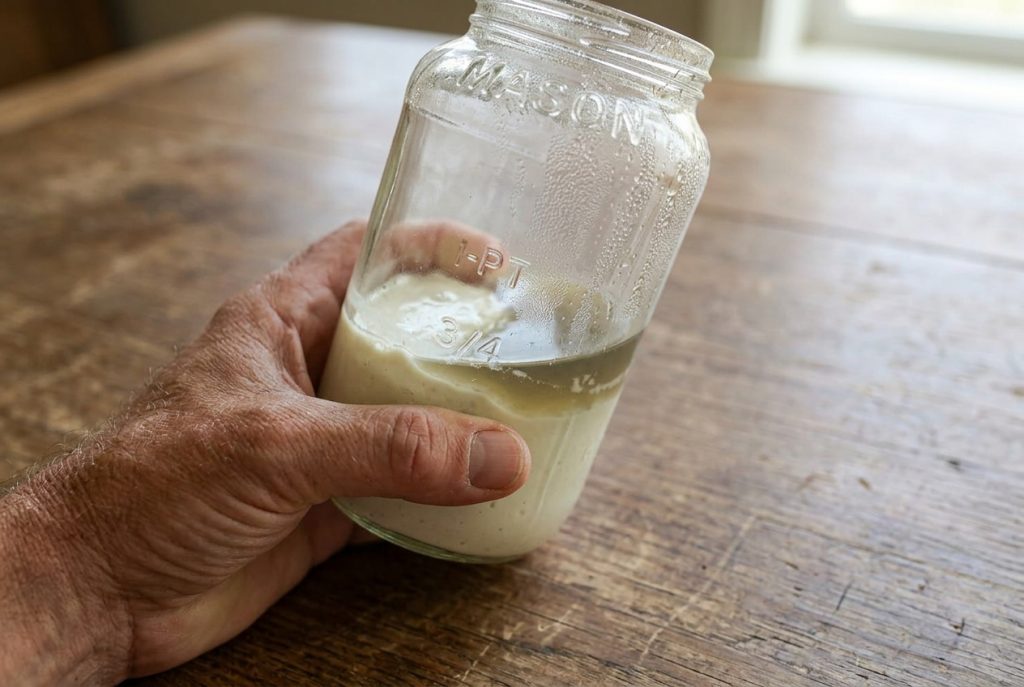
A layer of dark liquid on top. This is called “hooch,” and it is alcohol produced by hungry yeast that has run out of food. It is a signal, not a death sentence. Pour it off or stir it back in for a more sour flavor, then feed the starter. If you see hooch often, you are not feeding frequently enough or your kitchen is too warm.
It rose beautifully for a few days, then stopped. This is the single most common panic point, and it usually happens around days 3 to 5. What is often happening is a natural bacterial shift as the ecosystem sorts itself out. The early bubbling is sometimes caused by bacteria that then die off before the real yeast establishes. Keep feeding on schedule. Nine times out of ten, activity returns within a couple of days.
It smells sharply of acetone, nail polish, or alcohol. Your starter is starving. Increase the frequency of feedings and it will mellow back to a pleasant tang.
It is not rising at all. Usually a temperature problem. Wild yeast is sluggish below about 70 degrees Fahrenheit. Find a warmer spot, on top of the refrigerator, inside an oven with only the light on, or near a warm appliance. Also make sure you are not using chlorinated water, which can suppress the culture.
When to actually throw it out. True mold is the one real danger sign. If you see fuzzy growth in pink, orange, green, or black, or streaks of pink or orange liquid, discard the whole thing and start over. Do not try to salvage a moldy starter. That said, a normal healthy starter smells sour, tangy, or yeasty, never rotten, and a gray or beige color with hooch is perfectly normal.
From Starter to Loaf: The Basic Path Forward
Once your starter reliably passes the float test, baking bread follows a straightforward arc, even if mastering it takes practice. You feed the starter and wait until it is at its peak, bubbly and roughly doubled. You mix a portion of that active starter into a larger batch of flour, water, and salt to form your dough. You let the dough ferment slowly, often for several hours or overnight, developing flavor and structure while the wild yeast does the leavening. You shape it, let it rise a final time, and bake it, traditionally in a very hot oven, often inside a covered pot to trap steam and create a crackling crust.
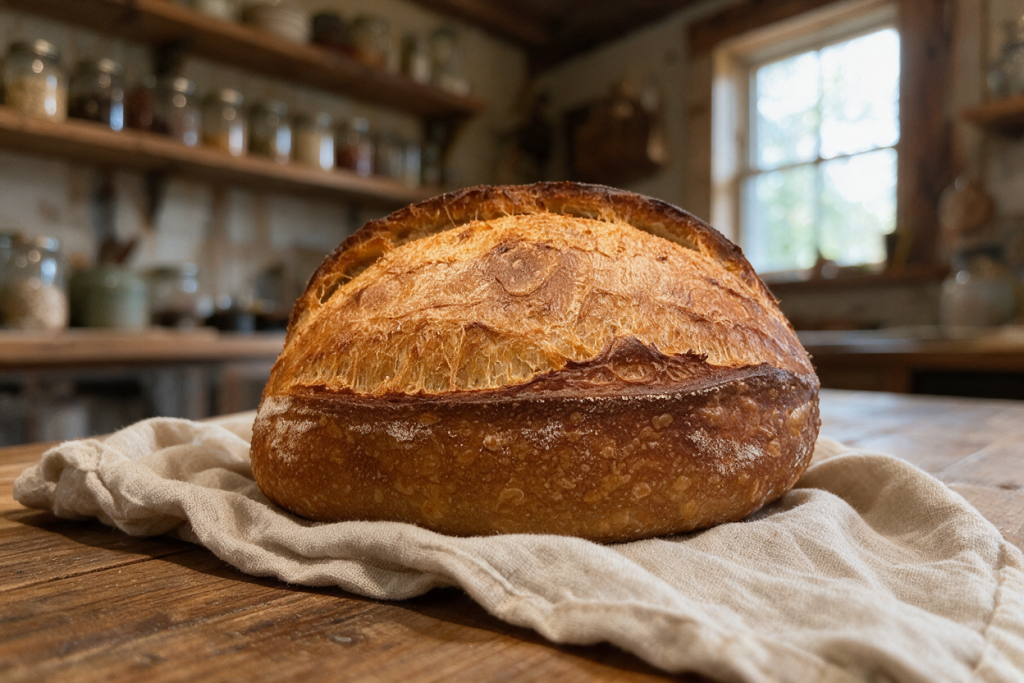
Here is a simple, forgiving formula for your first loaf once the starter is strong:
- 100 grams active starter, bubbly and at its peak
- 350 grams lukewarm water
- 500 grams bread flour
- 10 grams salt
Mix the starter, water, and flour until no dry bits remain, then let it rest 30 to 60 minutes so the flour fully hydrates. Work in the salt, then over the next 2 to 3 hours give the dough a “stretch and fold” every 30 to 45 minutes: grab one edge, stretch it up, fold it over the top, and turn the bowl a quarter each time. Let it bulk ferment at room temperature until it has risen by roughly half and looks puffy and domed, which can take 4 to 8 hours depending on how warm your kitchen is. Shape it into a taut ball, set it seam-side up in a floured bowl or proofing basket, and let it proof in the refrigerator overnight. The next day, bake it in a preheated covered Dutch oven at 475 degrees Fahrenheit, 20 minutes with the lid on to trap steam, then 20 to 25 minutes with the lid off to brown the crust to a deep, crackling gold.
The rhythm rewards patience. Where commercial yeast bread can go from flour to finished loaf in a couple of hours, sourdough asks for the better part of a day. But that time is exactly what develops the flavor, the digestibility, and the keeping quality that make it worth doing. It is slow food in the most literal sense, and it fits naturally into the rhythm of a self-reliant home. If you are working toward producing more of your own food from scratch, baking your own bread is one of the most satisfying and practical skills you can build. The kind of hands-on self-sufficiency laid out in The Self-Sufficient Backyard, which walks through growing, raising, and making your own provisions on a modest piece of land, turns a single loaf of homemade bread into part of a much bigger picture of independence.
Sourdough is also worth putting in the context of other frontier breads. When there was no time to let a starter work, or no starter at all, our ancestors had faster options. The Scottish explorer’s survival bread known as bannock could be mixed and cooked over a campfire in minutes, a useful complement to sourdough in any real self-reliance kitchen. Knowing both means you are never dependent on a store for the most basic food there is.
The Living Inheritance on Your Counter
There is something quietly radical about a sourdough starter in a world of shrink-wrapped, mass-produced everything. You are cultivating a living thing that turns two of the cheapest ingredients on earth into nourishing bread, using a technique that predates writing, and that fed prospectors, pioneers, sailors, and soldiers across thousands of years of human history. The wild yeast that raises your loaf was drifting in your own kitchen air. The bacteria came from your flour. Nothing was purchased except the raw grain.
Master this one skill and you have proven something to yourself that extends far beyond bread. You do not need a factory, a supply chain, or a special store to feed yourself well. You need knowledge, a little patience, and the willingness to tend something alive. The gold miners cradled their starters through freezing nights because they understood exactly what they had: not just food, but independence, in a jar. That same independence is available to anyone willing to mix flour and water and wait.
Start your jar today. In a week you will hold in your hands a piece of living history, one that, fed and cared for, can outlast you and pass to whoever comes next.
thanks for your help and strength