
Brine-Cured Meat: The Pioneer Recipe That Kept Pork Edible for Six Months
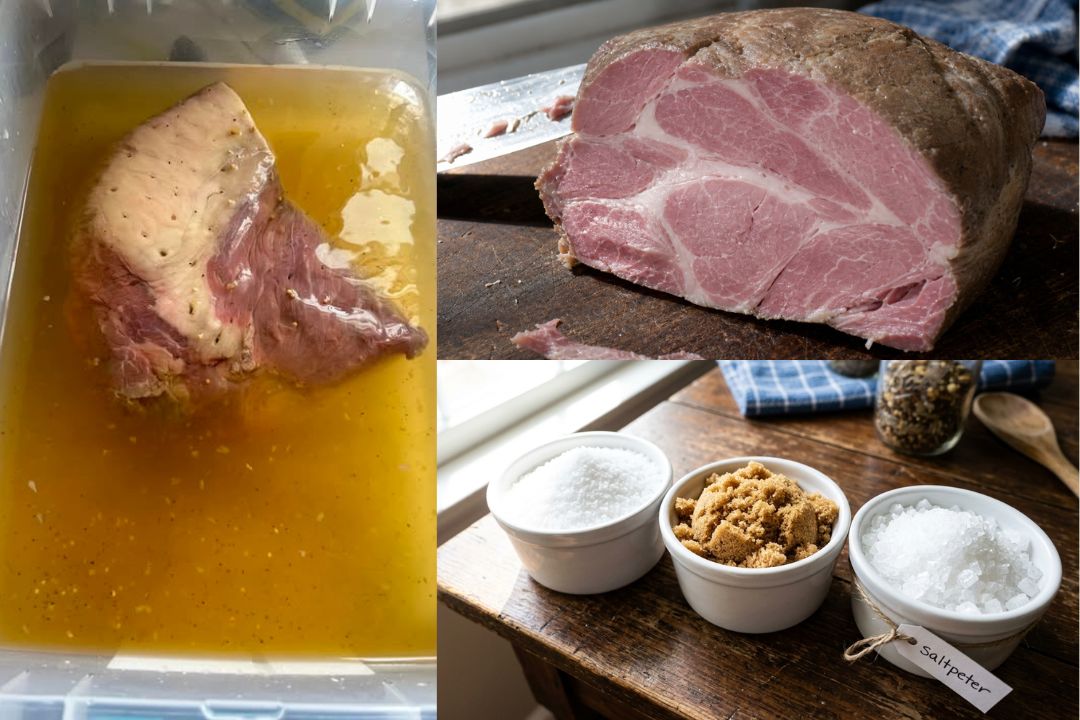
By the time the November wind cut hard enough to butcher the hog, a pioneer wife in 1850s Ohio knew exactly what came next. Every cut of that 800-pound animal had to last until the fields were warm again, and the household refrigerator hadn’t been invented yet. Her tools fit on a single pantry shelf: a scrubbed oak barrel, coarse rock salt, a small jar of crystalline saltpeter she’d traded for at the dry-goods store, and a brown paper twist of brown sugar. What she made with them (a brine of dissolved electrolytes that could keep pork edible from butchering day until the apple trees blossomed) wasn’t a recipe in any cookbook. It was knowledge passed mother to daughter, a chemistry lesson disguised as a chore.
That chemistry is still the most reliable shelf-stable preservation method available without electricity. And almost nobody alive today knows how to do it.
What “Electrolyte Preservation” Actually Means
The reason this brine works isn’t magic, and it isn’t merely the salt. When salt and saltpeter dissolve in water, both compounds dissociate into ions (sodium, chloride, potassium, and nitrate) which are, by definition, electrolytes. Each ion does something specific to the meat and to the bacteria trying to colonize it.
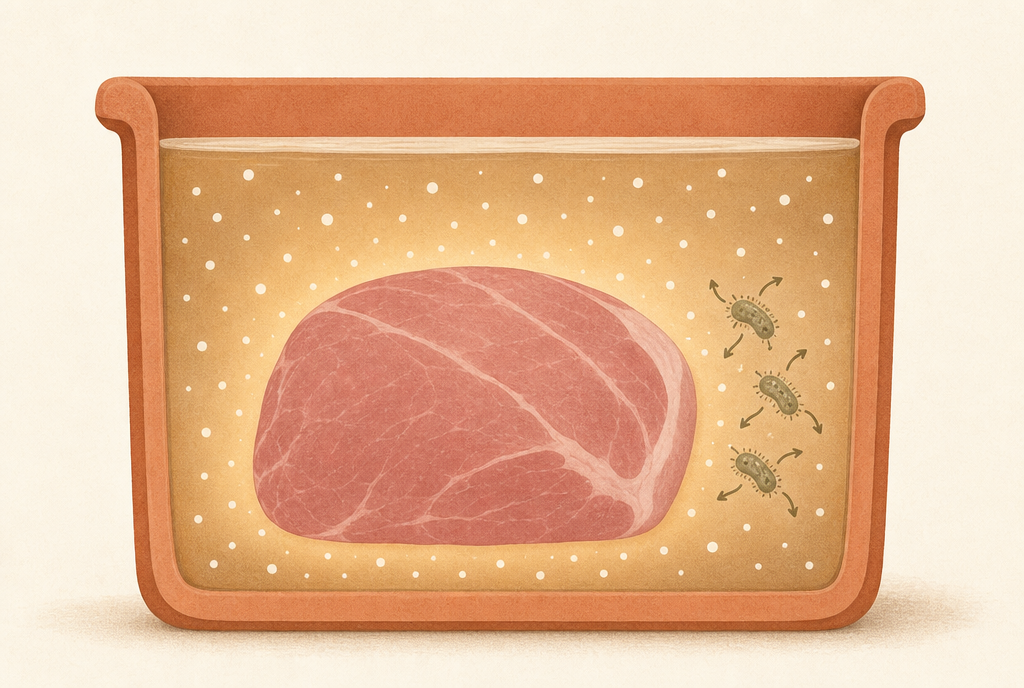
Sodium chloride goes to work first through a principle called osmotic pressure. Bacteria are basically tiny water-filled sacs. When you surround them with a solution that’s saltier than their internal fluid, water rushes out of the cell to try to equalize the concentration. The microbe collapses, dehydrates, and stops reproducing. Listeria, Salmonella, and most spoilage organisms shut down at brine concentrations above roughly 10% salt by weight. Staphylococcus aureus tolerates more, but it can’t grow once water activity drops far enough.
Potassium nitrate (what your great-grandmother called saltpeter) does something different and more important. The nitrate ion itself is largely inert, but bacteria already living on the meat slowly convert it into nitrite (NO₂⁻). Nitrite then reacts with myoglobin in muscle tissue to form nitrosomyoglobin, which gives cured meats their distinctive pink color. More critically, nitrite shuts down Clostridium botulinum, the bacterium that produces the deadliest natural toxin known to science. A 5% salt brine alone won’t stop botulism. A salt-and-nitrite brine will.
Sugar plays a quieter role: it tempers the harshness of the salt, supports the growth of beneficial lactic-acid bacteria that further acidify the meat, and contributes to the Maillard reactions that develop flavor when the cured meat is later cooked. It’s not optional. Brines made with salt alone produce hard, gray, leathery meat that nobody enjoys eating.
Together, the three ingredients create what food scientists call a hurdle system, multiple overlapping barriers that no single microorganism can cross. Salt dehydrates. Nitrite poisons the bacteria that tolerate salt. Sugar feeds the microbes that outcompete the harmful ones. Take any one ingredient out and the system fails.
The Brine That Built Empires
This wasn’t a marginal household trick. Brine curing fed armies, navies, and entire continents for the better part of three centuries.
By the 1790s, the British Royal Navy was provisioning more than 100,000 sailors at sea ,men who might not see a green vegetable for eighteen months. Their primary protein arrived in oak barrels stamped with the broad arrow of the Crown: salt beef and salt pork, packed in brine made to a precise admiralty specification. A captain whose meat went bad would write home about it. A captain whose meat killed his crew would face a court of inquiry.

Across the Atlantic, the same method was the literal lifeblood of the American Civil War. Union soldiers’ marching rations specified three-quarters of a pound of salt pork or one-quarter pound of fresh meat per day. Salt pork won that comparison every time, because it didn’t spoil between supply trains. The Confederate Army’s chronic shortage of salt (caused partly by Union blockades of southern saltworks) was so severe that General Robert E. Lee considered it a strategic weakness on par with shortages of gunpowder. Salt wasn’t seasoning. Salt was strategy.
For pioneer homesteaders, brine curing was simply how meat became food that lasted. A 19th-century newspaper recipe (the kind passed around farming communities in handwritten copies) gave the proportions plainly: fifteen pounds of salt, two and a half ounces of crude East Indian saltpeter, ten gallons of water, and three quarters of a pound of molasses. Meat cured in that brine for forty to forty-five days, after which it was hung in the smokehouse. A single hog, fully processed this way, could feed a family of six through an entire winter and into spring.
Brine curing was never the only tool in the pioneer pantry, it was one of half a dozen overlapping traditional food preservation techniques that worked together. The lacto-fermented vegetables sat next to the smoked hams. The dried beans waited beside the salt-cured beef. Each method covered what the others couldn’t, and a homestead that mastered the whole system was a homestead that ate well twelve months out of the year.
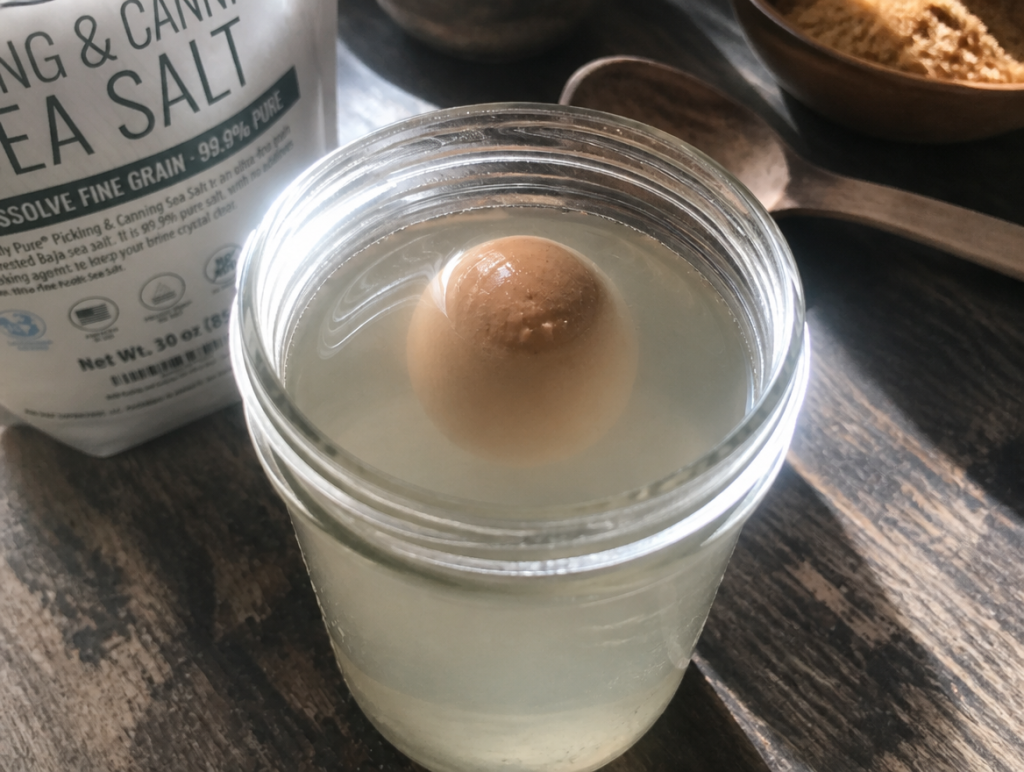
The technique was so ubiquitous that pioneer wives developed a folk test for brine strength: drop a fresh hen’s egg into the solution. If the egg sat on the bottom, add more salt. If it bobbed at the surface like a cork, add more water. When the egg floated with a quarter-sized circle of shell exposed to the air, the brine was right. That test corresponds to roughly a 17–20% salt concentration, exactly the range modern food scientists recommend for long-term wet curing.
The Three Ingredients, and Why Each One Matters
Before measuring anything, understand what each component is actually doing in the barrel. Substituting on a hunch is how cures fail.
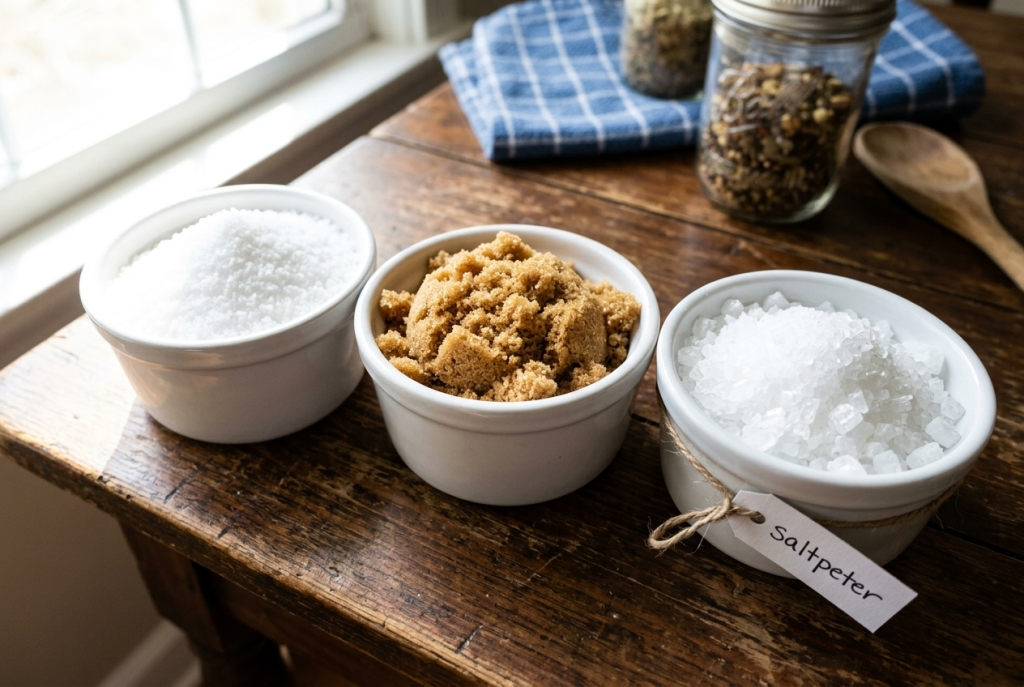
Salt must be pure sodium chloride. Iodized table salt will work in a pinch but tends to leave a metallic taste in long cures, and the anti-caking agents (silicon dioxide, calcium silicate) can cloud the brine. Pickling salt, kosher salt, or sea salt without additives is the right choice. Avoid Himalayan pink salt for this purpose, the trace minerals are nutritionally interesting but unpredictable in cure chemistry.
Sugar can be cane sugar, brown sugar, maple syrup, molasses, or honey. Cane gives a clean profile. Brown and molasses contribute depth and a slight reddish tinge. Maple is delicate and best for poultry. Choose by what you want the finished meat to taste like, but always include some form of sugar.
Saltpeter is the historical name for potassium nitrate (KNO₃). It’s a white crystalline powder, mildly sweet-tasting, that has been used in food curing for at least four hundred years and probably much longer. A teaspoon of saltpeter per quart of brine produces a level of nitrate consistent with traditional practice. Important caution: saltpeter is potent enough to be toxic at much higher doses. Do not exceed the recipe ratio. Store it labeled, sealed, and out of reach of children.
Modern food safety researchers and the USDA generally recommend home curers use Prague Powder #1 (sodium nitrite + salt, dyed pink) for cures lasting under 30 days, and Prague Powder #2 (sodium nitrite + sodium nitrate + salt) for cures lasting weeks to months. These give precise nitrite control where saltpeter requires bacterial conversion that can vary. We’ll cover the substitution math later. The traditional saltpeter recipe still works, and works well (it’s how this method was practiced for centuries) but precision matters more than tradition when you’re storing meat for half a year.
The Base Recipe
Two versions are worth knowing: a modest brine for shorter cures and refrigerated storage, and a heavy traditional brine for long-term, cool-cellar storage in the pioneer style.
Modest Brine, for cures under 30 days, refrigerated storage:
- 3 tablespoons pure salt (no additives)
- 2 tablespoons brown sugar
- 1 teaspoon saltpeter (or, preferred: 1 teaspoon Prague Powder #1)
- 1 quart filtered water
This is enough brine for roughly 1 to 1.5 pounds of meat. Scale linearly, for 4 pounds, use a gallon of brine and quadruple every ingredient.
Traditional Heavy Brine, for cures of 30–45 days, cool-cellar storage at 35–50°F:
- 1.5 pounds pure salt
- 3 ounces brown sugar (or ½ cup molasses)
- ¼ ounce saltpeter (or, preferred: 2 ounces Prague Powder #2)
- 1 gallon filtered water
This is the proportional descendent of the 19th-century newspaper recipe, about 17% salt by weight, the strength that floats an egg properly. It’s the version that pulls 6-month preservation off in a cool root cellar.
The difference matters. The modest brine is forgiving and produces eating-quality meat for the kind of timeline most home curers actually need. The heavy brine is a serious preservation cure, it requires extensive desalting before eating but produces meat that genuinely keeps without refrigeration.
Choosing the Right Cuts
Brine curing works best on cuts that meet three criteria: relatively lean, reasonably uniform thickness, and naturally dense muscle structure. Fat doesn’t take cure well, it can become rancid even when the lean tissue is fully preserved.
The historically proven cuts are:
Pork: shoulder (Boston butt), fresh ham, belly, loin. The belly becomes bacon. The ham becomes ham. The shoulder becomes the daily-driver salt pork that fed armies.
Beef: brisket, round, chuck. Brine-cured brisket with the right spice profile is corned beef. Round produces a dense, sliceable salt beef.
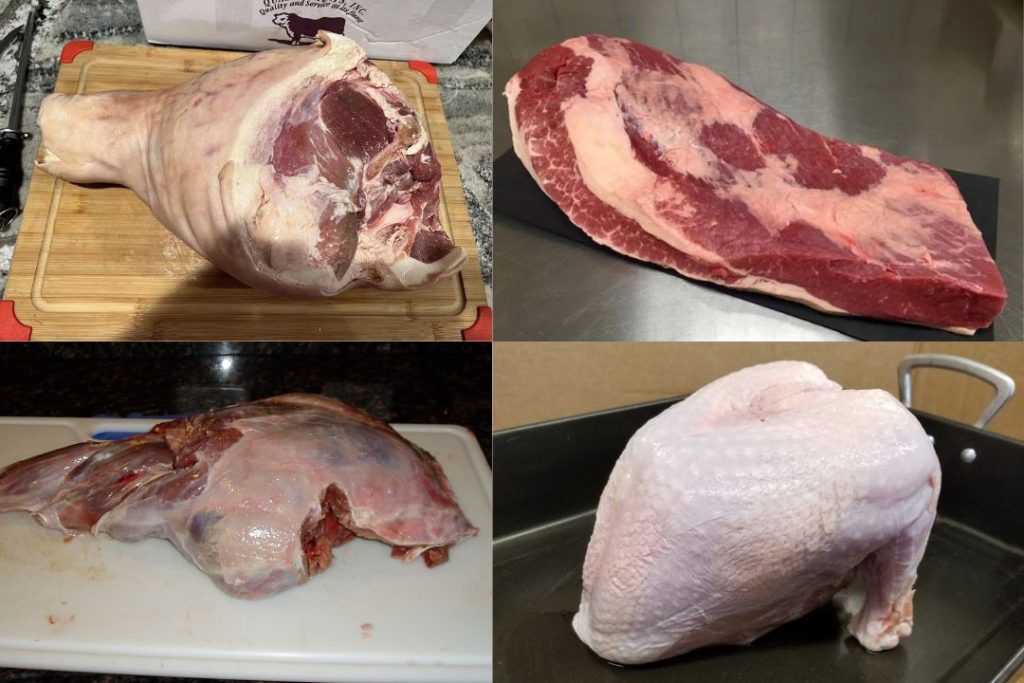
Game: venison hindquarter, elk round, wild boar shoulder. Game cures faster than pork because of lower intramuscular fat, reduce cure time by about 25%.
Poultry: whole chickens or turkey breast can be brined, but only for short cures (3–7 days). Long cures turn poultry rubbery.
What to avoid: heavily marbled cuts (ribeyes, well-marbled steaks), anything with thick fat caps left intact, and organ meats. If you want to cure a fattier cut, trim fat to no more than ¼ inch.
The single biggest factor in the quality of your finished cure is the quality of the meat going in. If you’re raising your own pork, beef, or poultry on your land, you control the cure from the moment the animal is harvested, and there’s no comparison to a store-bought brisket of unknown age and origin. The Self-Sufficient Backyard is the practical guide if backyard meat production isn’t yet part of your setup; it walks through small-scale chicken, rabbit, and pig systems on land you already own. The brine cure is downstream of the animal, but the animal is upstream of everything.
The Process, Step by Step
1. Prepare the meat. Trim away surface fat, silver skin, and any bone fragments from the butcher. Rinse and pat dry. For very thick cuts (over 4 inches), pierce the meat in a few places with a clean skewer or inject brine into the deepest tissue with a curing pump, this prevents the dreaded “bone sour” where bacteria reach the bone before the cure does.
2. Make the brine. Combine all ingredients in a non-reactive pot, stainless steel or enamel, never aluminum, copper, or cast iron. Bring to a hard boil and stir until every crystal of salt, sugar, and saltpeter is dissolved. Boiling sterilizes the brine; you cannot skip this step.
3. Cool the brine completely. This is the most commonly broken rule. Pouring warm brine onto raw meat creates a thermal zone where bacteria thrive for several hours before the cure activates. Refrigerate the brine until it’s at or below 40°F, overnight is ideal. Never use the brine until it’s stone cold.
4. Submerge the meat. Place the meat in a non-reactive container a food-grade plastic bucket, glass crock, or stainless stockpot. Pour the cold brine over until the meat is fully covered by at least an inch. Weight the meat down with a plate and a clean rock or sealed jar of water, any meat that surfaces will spoil.
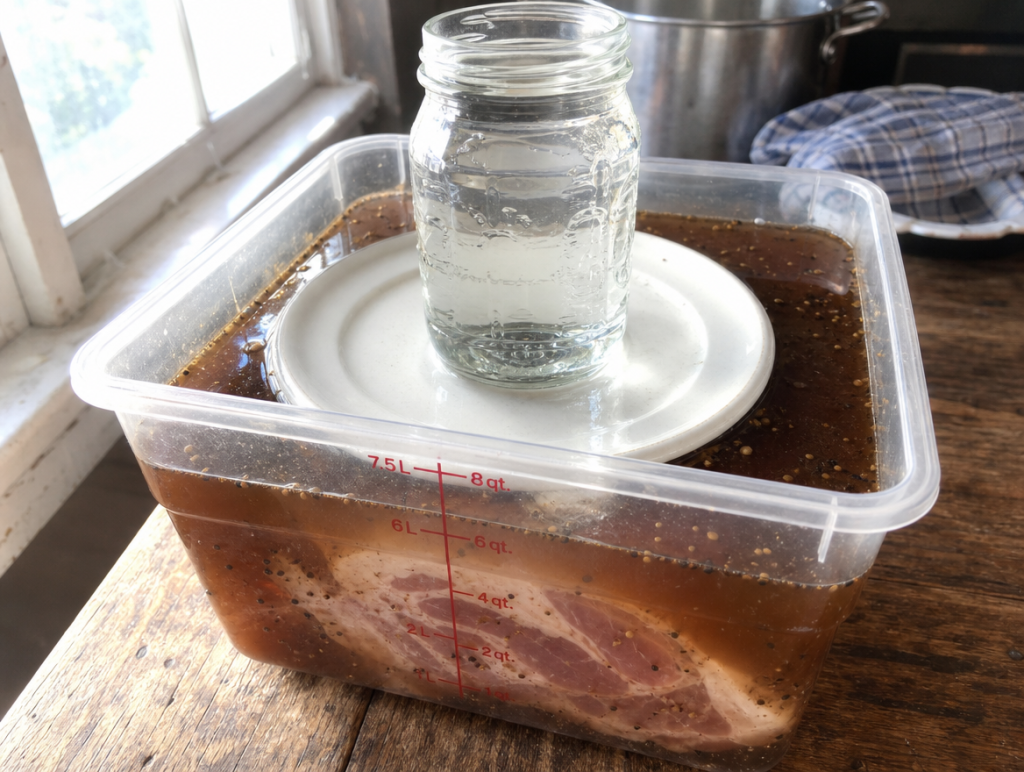
5. Hold at temperature. The brining vessel must stay between 35°F and 40°F throughout the entire cure. Warmer and bacteria outpace the cure. Colder and the cure penetrates so slowly that the interior of thick cuts may never fully cure. A cool basement, root cellar, or dedicated refrigerator works. A garage in a Maine February works. A garage in a Tennessee September does not.
6. Time the cure. The traditional rule is one day per pound of meat, plus two extra days for safety. A 5-pound brisket cures for 7 days. A 12-pound ham cures for 14 days. The heavy traditional brine extends this to 30–45 days for serious long-term storage. Flip the meat every 2–3 days to ensure even penetration.
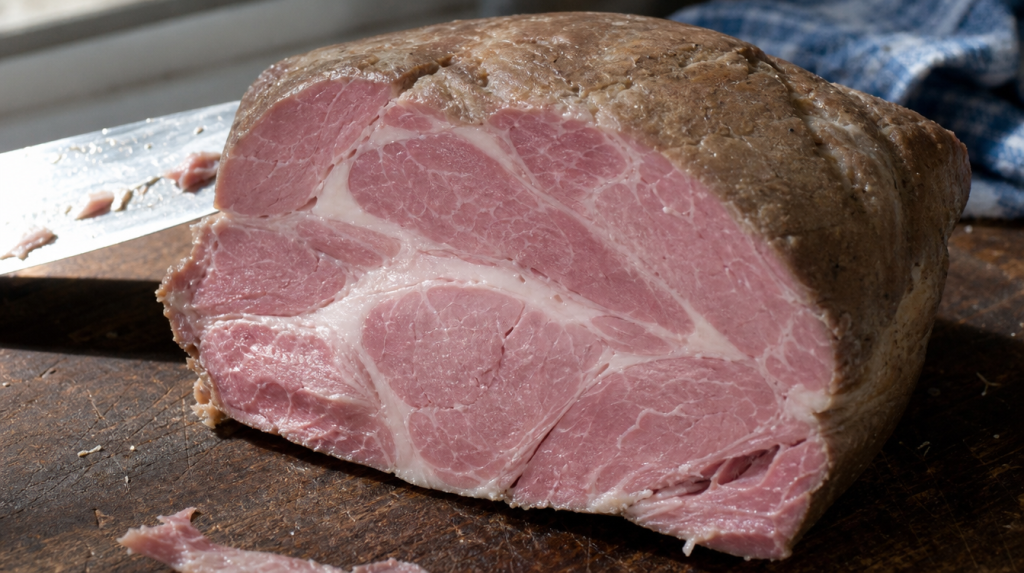
7. Test, dry, and store. When the cure is complete, the meat should feel firm throughout (not soft in the center), the color should be uniformly pink-rose all the way through when sliced, and the surface should have a slight tackiness from the dissolved proteins. Rinse briefly under cold water, pat dry, and either smoke it, hang it in a cool dry place wrapped in cheesecloth, or refrigerate it whole for use over the coming weeks.
Storage Conditions and Realistic Shelf Life
Cured meat is shelf-stable, not invincible. The conditions you store it under determine whether it lasts six weeks or six months.
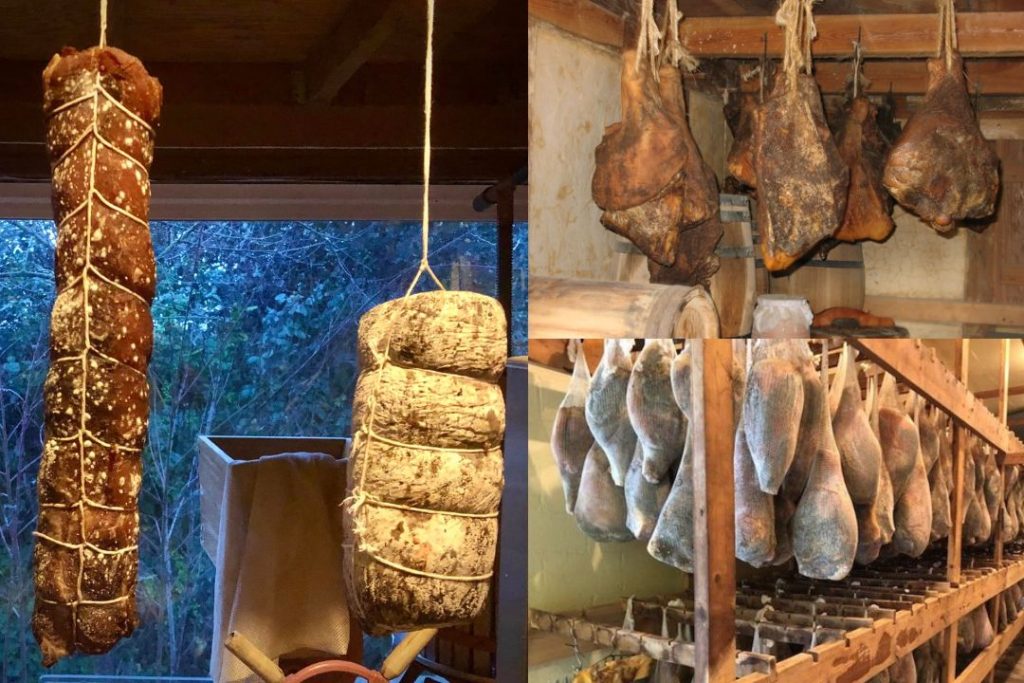
Ideal long-term storage conditions are 35–55°F, 60–70% relative humidity, dark, and well-ventilated. A traditional springhouse, root cellar, or unheated basement in a northern climate hits all four. A modern refrigerator hits temperature but not humidity, which can dry the meat too aggressively over months.
In the heavy brine, properly cured and properly stored, you can expect:
- Salt pork (pork belly or shoulder, heavy cure, cellar storage): 6–12 months
- Salt beef (brisket or round, heavy cure, cellar storage): 4–6 months
- Country ham (heavy cure, hung and dry-aged): 1–3 years
- Modest-cure brined meats (refrigerated): 4–6 weeks
For storage windows beyond a year (true multi-year shelf life) brine curing hits its limit. That’s where the Plains tribes’ pemmican takes over: dried lean meat pounded with rendered fat and dried berries, capable of sitting on a shelf for five-plus years without spoiling. Pemmican and brine-cured meat aren’t competitors, they’re partners covering different timelines. Use brine curing for the meat you’ll eat over the next six months; render the rest into pemmican for your deep storage.
Inspect cured meat weekly. Surface mold during dry-aging is normal, wipe it off with a vinegar-soaked cloth. Sliminess, sour smell, gas, or bulging packaging means the cure failed and the meat must be discarded. Trust your nose. Cured meat smells salty, faintly tangy, and clean. Spoiled cured meat smells unmistakably wrong.
The Modern Alternative: Prague Powder
Saltpeter is harder to source than it was a century ago. Some U.S. states restrict its sale (it’s also a component of black powder), and quality varies wildly between suppliers. Prague Powder is the modern, food-grade replacement that home curers can buy from butcher-supply companies and most online cooking retailers.
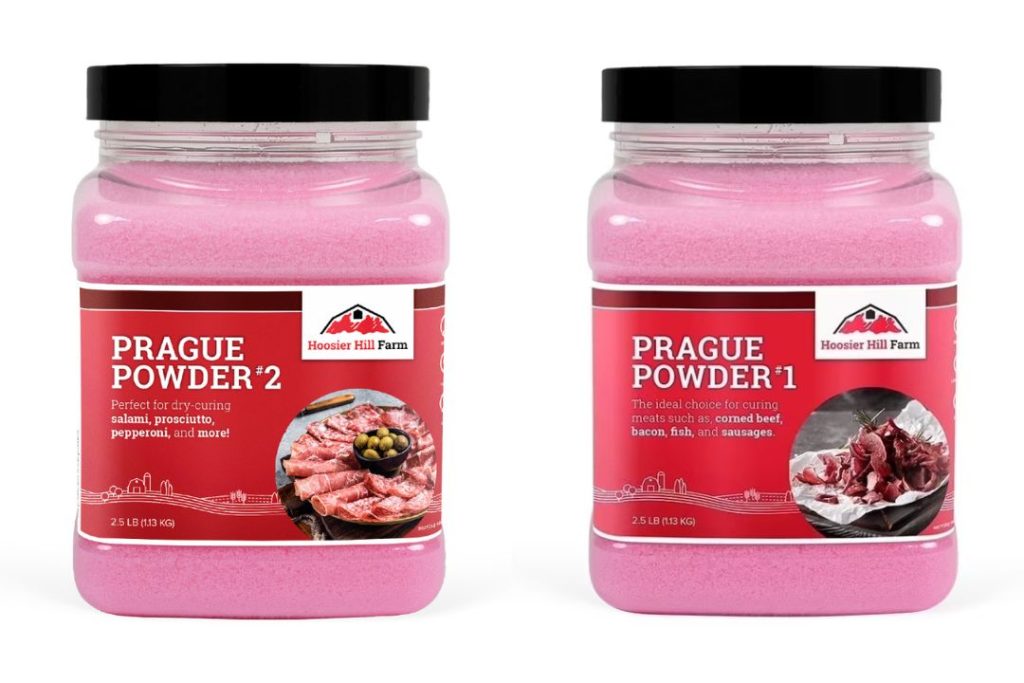
Prague Powder #1 is 6.25% sodium nitrite blended with 93.75% salt and dyed pink to prevent confusion with table salt. Use it for cures of 30 days or less — bacon, pastrami, corned beef, smoked sausage. The standard ratio is 1 teaspoon per 5 pounds of meat (for dry cures) or 1 teaspoon per quart of brine (for wet cures).
Prague Powder #2 contains both sodium nitrite and sodium nitrate, blended with salt. The nitrate slowly converts to nitrite over weeks, which is exactly what you need for long-aged dry-cured meats — country hams, salami, prosciutto. The standard ratio is 1 teaspoon per 5 pounds of meat.
If you substitute Prague Powder for saltpeter in any recipe in this article, use the same volume measurement (1 teaspoon Prague Powder for 1 teaspoon saltpeter) and you’ll be in the safe range. Prague Powder gives more predictable results because the nitrite content is precisely calibrated, where saltpeter relies on bacterial conversion that varies with temperature and time.
This is one of those places where modern technology genuinely improves on traditional practice. Use Prague Powder for any cure you intend to feed to children, pregnant women, or anyone with health conditions sensitive to nitrate exposure. Save the saltpeter for historical authenticity projects and short cures where you want the experience of doing it the old way.
Variations and Spice Additions
A plain salt-sugar-saltpeter brine produces serviceable cured meat. The classic brines that built reputations across the centuries added botanicals.
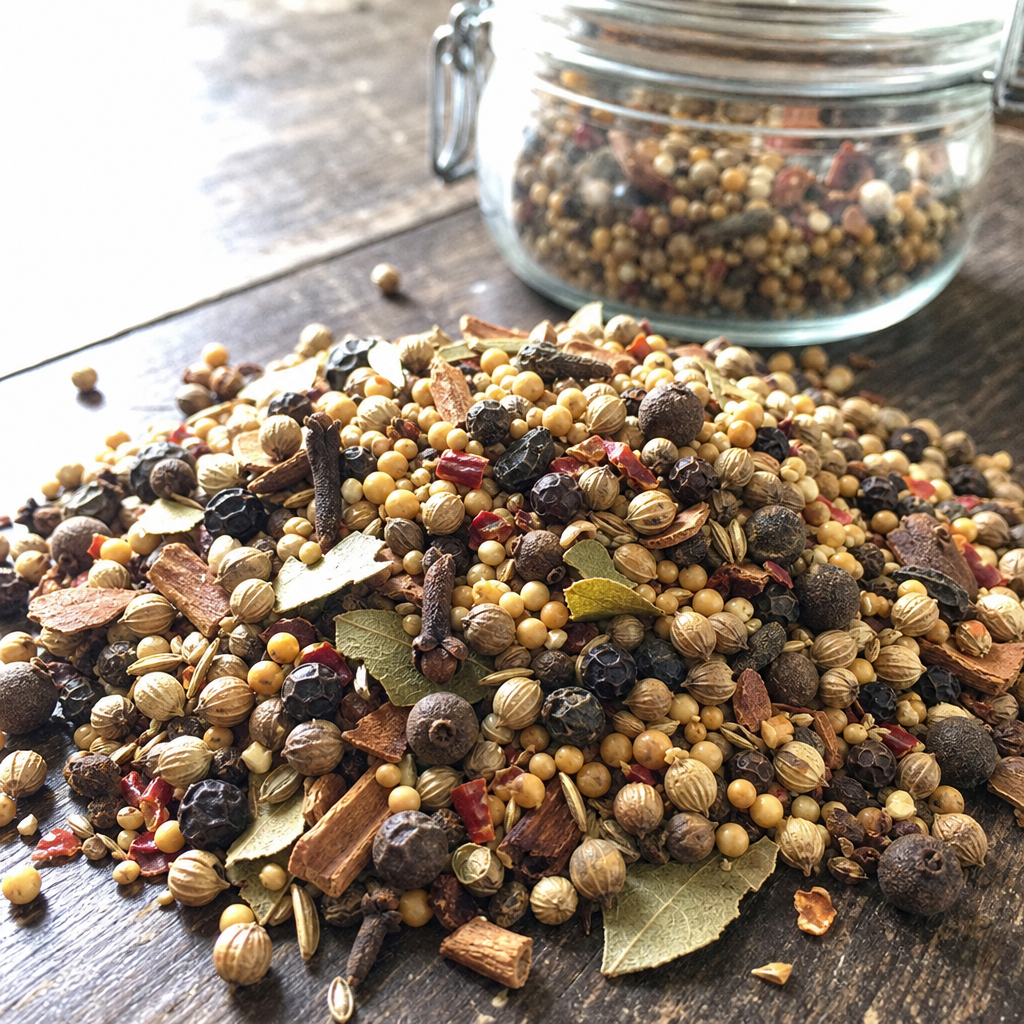
Corned beef (the brisket version): add 2 tablespoons pickling spice per gallon, black peppercorns, mustard seed, coriander seed, allspice berries, juniper berries, bay leaf, whole cloves, ground ginger, red pepper flakes. The Irish-American version is heavier on coriander and mustard. The Jewish-deli version goes lighter on cloves, heavier on black pepper.
Country ham brine: add ¼ cup whole black peppercorns, 6 bay leaves, 1 whole head of garlic crushed, and a small handful of juniper berries per gallon. Some Appalachian recipes also include sassafras root for an unmistakable regional character.
Game cure: add 2 tablespoons crushed juniper berries, 1 tablespoon black peppercorns, and a few sprigs of fresh thyme or rosemary per gallon. Juniper is particularly important for game, it cuts the muskiness that puts some people off venison and elk.
Sweet cure (Virginia ham style): double the sugar (or substitute molasses), add 1 cinnamon stick and ½ cup of honey per gallon. Produces the hallmark Smithfield-style flavor.
Adding spices doesn’t change the preservation chemistry, that’s still the salt-sugar-nitrate trio doing the work. Spices add to flavor and aroma without affecting shelf life, so feel free to experiment.
What Goes Wrong, and How to Fix It
Most failed brine cures share a small handful of root causes.
Spoilage at the center of thick cuts (bone sour). Cure didn’t penetrate fast enough. Solution: pump brine into thick cuts with a curing injector, or split very thick cuts into smaller pieces before brining.
Surface slime or rotten smell. Brine wasn’t cold enough, meat wasn’t fully submerged, or temperature drifted above 40°F during the cure. Discard the meat. Don’t try to salvage it.
Hard, gray, leathery texture. Brine was too salty, cure ran too long, or the meat was insufficiently desalted before cooking. Reduce cure time by 25% next batch and soak finished meat in fresh cold water for 12–24 hours before cooking.
Pale color, no characteristic pink. Insufficient nitrite/nitrate. Either the saltpeter was too old to work (it loses potency over years) or you skipped it entirely. Color isn’t just cosmetic, pink color confirms the botulism-inhibiting reaction occurred. Pale cured meat may not be safe.
Cloudy or stringy brine partway through the cure. Some protein clouding is normal. Active fermentation (bubbling, sour smell) at temperatures above 40°F means the cure has been compromised. Pull the meat, inspect carefully, and either re-brine in fresh cold solution or discard.
White surface mold during dry-aging. This is almost always Penicillium or related benign molds and is part of traditional dry-curing. Wipe with a vinegar-soaked cloth. Black, green, or red mold means trouble, discard.
Bringing It to the Table
Brine-cured meat (especially from the heavy cure) is too salty to eat directly. The desalting step is non-negotiable for traditional preparations.
Soak the meat in fresh cold water for 12–24 hours, changing the water every 6 hours. Thicker cuts need longer soaks; a country ham may need 36–48 hours of soaking before it’s edible. Then cook it as you would any uncured cut of the same kind: simmer salt pork with beans, slice corned beef thin and braise, glaze and bake a country ham.
If you’ve used the modest brine, desalting is much briefer, a quick rinse and a 1–2 hour soak is usually enough.
A note on traditional rendering: the fat trimmed from cured meat can be saved and rendered into seasoned cooking fat that lasts months on its own. If you’re already butchering and curing your own animals, rendering your own beef tallow is the natural next skill, nothing on a homestead animal goes to waste when you know what to do with it.
The Forgotten Pantry — Beyond the Brine Barrel
Mastering brine curing changes something fundamental about how you think about food security. You stop seeing your freezer as a single point of failure and start seeing it as one preservation method among several. A power outage that would ruin a freezer full of expensive meat doesn’t faze a smokehouse full of cured ham. A truck-strike or a panic-buying spree at the grocery store doesn’t matter when your pantry runs on pioneer rules.
But brine-cured meat is one piece. The full pioneer pantry rested on dozens of forgotten recipes and methods, the kind of knowledge that used to live in a grandmother’s head and now lives almost nowhere. The four-ingredient hardtack that fed Civil War soldiers for a week per pound. The Civil-Defense Era “Doomsday Ration” the U.S. military designed to keep a person alive on 700 calories a day. The Russian ration bread that fed the Red Army through the siege of Leningrad. The Native American methods of preserving wild berries and meat into compounds that lasted years on a shelf. The Depression-era recipes that kept families fed through the worst years of the 20th century.
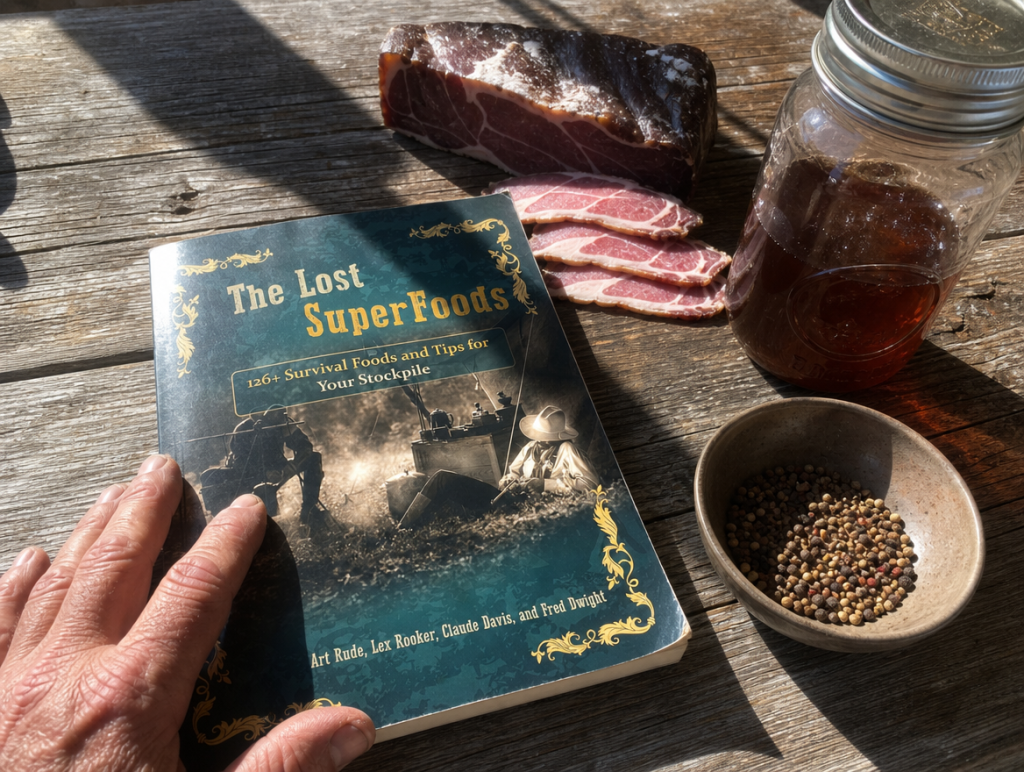
Most of these methods are documented exactly nowhere except in The Lost SuperFoods, a 270-page hardcover that compiles 126 of these forgotten preservation recipes and techniques into one reference. It’s the only book I’m aware of that puts traditional brine cures, frontier-era preserved meals, military survival rations, and Native American pemmican variants under one cover with the actual ratios, timing, and step-by-step methods you need to make them work in your own kitchen.
If you cured a brisket using this article and it changed how you think about meat storage, The Lost SuperFoods is what you reach for next. It’s the difference between knowing one preservation skill and owning the entire pioneer playbook, the same playbook that kept families fed through wars, depressions, and winters far harsher than anything most of us have ever lived through. Get The Lost SuperFoods here →
What You’re Actually Building
The first time you pull a successfully cured ham out of a brine barrel and hang it in your smokehouse or basement, or unused refrigerator, something shifts. You’ve just done the thing that fed your great-great-grandparents through their winters. You’ve re-acquired a piece of operational knowledge that was, until that moment, lost to your family line.
Modern grocery stores have made this skill seem quaint. They shouldn’t. The supply chain that gets vacuum-sealed brisket to a refrigerated case is enormously more fragile than a barrel of brine in a cool basement. Power grids fail. Trucks stop running. Stores empty out. The brine doesn’t care about any of that.
Three tablespoons of salt, two tablespoons of sugar, one teaspoon of saltpeter, one quart of water. Boil, cool, submerge, wait. The same simple formula that crossed the Atlantic in oak barrels, that fed armies on the march, that hung in smokehouses from Maine to Texas while the snow piled up outside, and the same formula that’s available to you, now, the next time you bring home a brisket or split a hog with a neighbor.
Your ancestors knew this. So can you.